
Governance
The role of the administrative, management, and supervisory bodies (GOV-1)
From the KION Group’s point of view, being transparent, sustainable, and socially responsible, taking account of the societal expectations of stakeholders and the associated management of resources and environmental protection, as well as compliance with and strengthening of living and working conditions, are key criteria for the Group’s long-term business success.
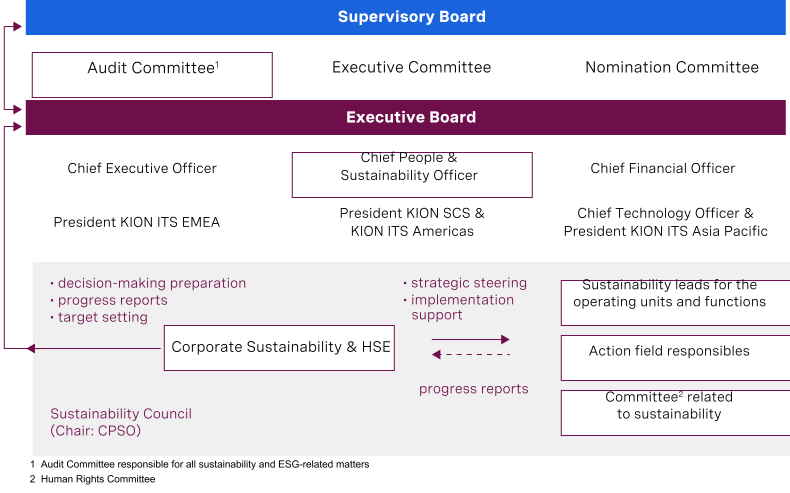
The Executive Board of KION GROUP AG bears collective responsibility for the corporate strategy and is responsible for aligning sustainability targets with the Company’s wider goals. It must ensure that decisions are guided by environmental and social aspects as well as commercial aspects. The Executive Board involves the Supervisory Board and, specifically, the Audit Committee in the development of the sustainability strategy and makes ongoing adjustments to the strategy. The Supervisory Board monitors the Executive Board’s implementation of the sustainability strategy and assists the Executive Board in an advisory capacity.
The administrative, management, and supervisory bodies (AMSB) comprised a total of 22 members as at December 31, 2025, the same number as at the end of 2024. In the aforementioned bodies 27.3 percent of the positions were held by women in 2025 (2024: 27.3 percent).
Bodies |
2025 |
2024 |
||||
|---|---|---|---|---|---|---|
Executive Board |
6 |
6 |
||||
Gender diversity ratio on the Excecutive Board1 |
20.0% |
20.0% |
||||
Supervisory Board |
16 |
16 |
||||
Gender diversity ratio on the Supervisory Board1 |
45.5% |
45.5% |
||||
thereof Employee Representatives |
8 |
8 |
||||
thereof independent from undertaking and Executive Board (in %)2 |
81.3% |
81.3% |
||||
AMSB KION GROUP AG in total |
22 |
22 |
||||
|
||||||
The CEO is responsible, in particular, for the corporate strategy, including its communication to the Supervisory Board and other stakeholders, and for its implementation in operations.
Within the Executive Board, the CPSO is responsible for human resources and sustainability issues, including occupational health and safety. Her role also entails responsibility for ensuring that the sustainability strategy is developed and implemented in line with the KION Group’s goals. She also chairs the Sustainability Council, to which the action field leads, sustainability leads from the Operating Units and functions, and members of Corporate Sustainability & HSE also belong. Another responsibility of the CPSO is to ensure that all relevant sustainability-related data is captured across the Group and regularly presented to the administrative, management, and supervisory bodies. The remit also encompasses actively supporting the implementation of ESG targets in the Group and strengthening its culture of responsible business.
A central task of KION’s sustainability reporting is to provide regular updates on current developments and actions to the Supervisory Board, which is informed at least every six months about progress made toward sustainability targets and about strategic initiatives and their impact on the KION Group. The Audit Committee reads these progress reports before they are discussed by the Supervisory Board. For urgent matters, additional ad hoc reports are made to the Audit Committee to ensure its ability to respond rapidly.
The Supervisory Board’s Audit Committee is responsible for all sustainability issues. This non-financial report also falls within its remit. Close collaboration between the Executive Board and the Supervisory Board ensures that sustainability is continually and effectively promoted and embedded in all areas of the Company. A key tool is the materiality analysis, which is performed by Corporate Sustainability & HSE in collaboration with the relevant departments and stakeholders and is signed off by the Executive Board. The results of the analysis are presented to the Supervisory Board for information and discussion.
The Executive Board of KION GROUP AG, primarily the CEO and CPSO, sets targets, makes decisions on sustainability matters for the KION Group, and is responsible for monitoring sustainability-related impacts, risks, and opportunities of the Company’s activities.
Roles and responsibilities at a glance in relation to sustainability and ESG topics
In order to perform their duties properly, the governing bodies must possess in-depth knowledge in all areas of sustainability and enhance that knowledge at regular intervals. In connection with the Company’s targets, the Supervisory Board adopted a profile of skills and expertise for itself in 2017, which is regularly reviewed. The last review was carried out in 2025. The sustainability expertise of the Executive Board and Supervisory Board is also enhanced through training and advice from experts. The Supervisory Board believes that, in its current composition, it has adequate sustainability-related skills and expertise in terms of sufficient practical experience (skills) and/or professional/academic training and knowledge (expertise). »An overview of sustainability-related skills and expertise in the AMSB can be found in the ‘Profile of skills and expertise for the Supervisory Board’ chapter.«
Prior to taking up her position as CPSO of KION GROUP AG on May 1, 2023, Valeria Gargiulo already possessed the requisite functional and practical skills in sustainability management, acquired in her previous role in the automotive industry. She also has a long and successful track record in HR management.
Information provided to and sustainability matters addressed by the undertaking’s administrative, management, and supervisory bodies (GOV-2)
The employees of the KION Group are consulted on an ongoing basis through the representative functions (Corporate Sustainability, action field leads, sustainability leads from the Operating Units and central functions) established by the various governing bodies for the three regions EMEA, APAC, and the Americas. This enables employees’ perspectives on potential impacts, risks, and opportunities in the value chain to be considered in operational decision-making on an ongoing basis. Progress is regularly reviewed by the sustainability leads, the action field leads, Corporate Sustainability, and special committees. The progress reports prepared for each region and function are submitted to Corporate Sustainability and the Sustainability Council and are presented in Executive Board meetings as part of the KION Group’s groupwide strategy development and implementation. The action field leads manage the overall programs and targets at Group level. They also assign the agreed targets to the individual segments, regions, and functions and monitor progress toward achievement of the sustainability strategy targets.
As part of this process, the Executive Board is regularly updated, at least once per quarter and on an ad hoc basis, on sustainability topics, risk analyses, and progress with strategic targets.
The Sustainability Council, chaired by the CPSO, was introduced in 2023 to succeed the sustainability steering group, which had been created in 2017. The Sustainability Council members include the action field leads, the sustainability leads in the segments, regions, and functions, and members of Corporate Sustainability. The Council meets every six to eight weeks in order to drive forward strategic initiatives related to sustainability. The Council prepares decision proposals for the Executive Board and oversees implementation of the sustainability program across the KION Group. Corporate Sustainability & HSE supports the KION Group in the integration of sustainability in processes and decisions. It informs the Executive Board and Supervisory Board about related developments and progress on a monthly basis. These reports serve as a key basis for making decisions about further steps in connection with the IROs.
Within the bounds of applicable legal provisions, the KION Group also regularly discusses sustainability-related topics with external organizations. This includes its participation in professional associations and regular meetings with analysts, investors, and advisory firms. As part of its corporate governance, the KION Group also considers sustainability matters of relevance for its business model when establishing targets, actions, and due diligence processes. To be able to fulfill its due diligence obligation with regard to sustainability, the Executive Board is informed about progress, developments, impacts, risks, and opportunities at regular intervals. Corporate Sustainability is responsible for reporting. Information is also shared with the administrative, management, and supervisory bodies through regular meetings of the Sustainability Council. Should serious events occur, the Executive Board also requests proactive ad hoc reports, the provision of which must be ensured.
Risks and infringements can also be reported directly and anonymously though the Compliance department and its compliance management system (such as the whistleblowing system), meaning that these information channels can also be used for sharing sustainability-related information with the administrative, management, and supervisory bodies.
The Executive Board and the Supervisory Board dealt with all material impacts, risks, and opportunities in the reporting year. A list of material impacts, risks, and opportunities can be found in the topical standards in the disclosure requirements for SBM-3.
Integration of sustainability-related performance in incentive schemes (GOV-3)
The Executive Board of the KION GROUP AG bears collective responsibility for achieving the Group’s short-, medium-, and long-term sustainability targets. For this reason, sustainability-related performance incentives are an integral element of the Executive Board’s system of remuneration. The incentive structures for the Executive Board of KION GROUP AG and for senior management are an important lever for driving progress in the area of sustainability.
When setting Executive Board remuneration, the Supervisory Board places particular emphasis on sustainability – by considering social and environmental aspects – as well as on the Company’s long-term growth. It does so by giving a high weighting to the variable remuneration components.
The variable Executive Board remuneration comprises a one-year variable component based on the current financial year (short-term incentive – STI) and a multiple-year variable component based on a forward-looking three-year performance period (long-term incentive – LTI). The variable components of Executive Board remuneration comprise both short- and long-term targets, which are derived from the corporate strategy, including non-financial targets in the sustainability strategy. To ensure that the non-financial sustainability targets remain relevant to the strategy, the Supervisory Board determines the specific targets based on a selection of verifiable ESG targets, which were set for the KION Group’s business model and were identified as material for the achievement of the defined sustainability targets.
Both the short-term and the long-term variable remuneration incorporate two ESG performance targets. In each case, the ESG targets account for 20 percent of short-term and long-term variable Executive Board remuneration.
For the STI 2025, the Supervisory Board defined the following two non-financial targets, each with a weighting of 10 percent:
The target chosen for the STI 2025 from the ‘occupational health and safety’ category was the lost time injury frequency rate (LTIFR). This metric indicates the frequency of accidents in the KION Group resulting in lost time of at least one shift per one million hours worked.
Energy intensity was chosen as the new non-financial measure of performance defined for the STI 2025 from the ‘sustainability and environment’ category, replacing the ISO certification rate used for the STI 2024. The budgeted energy intensity metric is the ratio of total energy consumption to the Group’s revenue.
For the performance periods of the LTI starting up to 2023, the Supervisory Board defined the following two non-financial targets, each with a weighting of 10 percent:
In the ‘attractiveness as an employer’ category, the results of the annual KION Pulse employee survey are used, specifically the participation rate and the engagement score, each with a weighting of 5 percent. The engagement score measures employees’ motivation and commitment.
The non-financial measure of performance chosen in the ‘sustainability and environment’ category for the LTI 2023–2025 was the score achieved in the independent sustainability rating S&P Global CSA, which evaluated the KION Group and its progress based on various criteria.
For the three-year LTI performance periods starting from 2024, the GHG emission reduction pathway (Scope 1 and 2) replaced the S&P Global CSA rating as the new target aimed at achieving the defined climate targets.
The Remuneration Committee prepares all Supervisory Board resolutions, especially in connection with the Executive Board members’ variable remuneration components (setting of targets and target achievement for the short-term and long-term variable components of remuneration).
The Supervisory Board’s Remuneration Committee comprises five members. Three of its members are shareholder representatives and two are employee representatives. It is always chaired by the chairman of the Supervisory Board. The Remuneration Committee primarily deals with matters relating to Executive Board remuneration and the remuneration report that has to be prepared each year. In accordance with section 87a AktG, the Supervisory Board of KION GROUP AG is responsible for setting and regularly reviewing the Executive Board remuneration system of KION GROUP AG and the total pay of the individual members of the Executive Board. The Remuneration Committee is responsible for preparing all Supervisory Board resolutions pertaining to the Executive Board’s remuneration.
Statement on due diligence (GOV-4)
Core elements of due diligence |
Topical ESRS |
Page(s) in PDF |
|---|---|---|
a) Embedding due diligence in governance, strategy and business model |
ESRS 2 SBM-3; GOV 1; GOV-2; GOV-3; GOV-5 |
124 – 131 |
ESRS 2 SBM-3: E1; E2; E5 |
133 – 138; 156 – 157; 161 – 163 |
|
ESRS 2 SBM-3: S1; S2 |
178 – 179; 193 – 194 |
|
ESRS 2 SBM-3: G1 |
200 – 201 |
|
b) Engaging with affected stakeholders in all key steps of the due diligence |
ESRS 2 IRO-1; SBM-2; GOV-2 |
115 – 120; 121 – 124; 127 – 128 |
ESRS 2 MDR-P: E1; E2; E5 |
138 – 140; 157 – 159; 163 – 163 |
|
ESRS 2 MDR-P: S1; S2 |
182 – 185; 194 – 195 |
|
ESRS 2 MDR-P: G1 |
201 – 202; 203 – 204 |
|
c) Identifying and assessing adverse impacts |
ESRS 2 IRO-1 |
115 – 120 |
d) Taking actions to address those adverse impacts |
ESRS 2 MDR-A: E1; E2; E5 |
140 – 143; 159 – 160; 163 – 165 |
ESRS 2 MDR-A: S1; S2 |
185 – 186; 197 – 198 |
|
ESRS 2 MDR-A: G1 |
203 – 203 |
|
e) Tracking the effectiveness of these efforts and communicating |
ESRS 2 MDR-T: E1; E2; E5 |
143 – 147; 160 – 160; 165 – 166 |
ESRS 2 MDR-T: S1; S2 |
186 – 187; 198 – 199 |
|
ESRS 2 MDR-T: G1 |
203 – 203 |
Risk management and internal controls over sustainability reporting (GOV-5)
As part of its internal control mechanisms, the KION Group regularly records risks in the Group through a systematic, groupwide analysis and assessment. The risks include corruption and bribery risks, money laundering risks, and risks of non-compliance in connection with antitrust laws, tax regulations, and cybersecurity rules. Sustainability-related risk, such as human rights abuses or environmental breaches in the supply chain, are also systematically recorded. To this end, the KION Group has established a supplier management process in which infringements of protected rights in the supply chain are defined.
In the assessment of potential risk, the characteristics of the corruption perception index for the respective country, the size and structure of the local procurement or sales organization, and contacts with public officials are considered. The groupwide risks are assessed and then assigned a priority in a standardized process. Newly emerging non-financial risks are documented and prioritized. Appropriate actions are subsequently determined to eliminate weaknesses, both in processes and control mechanisms.
At regular meetings, the highest supervisory body – the Supervisory Board – is informed of the current situation in the areas of occupational health, safety, and the environment. The Supervisory Board also monitors and checks significant sustainability-related risks in relation to corrective actions taken. Furthermore, it is involved in every key step of the implementation of fundamental initiatives for the future of the Company through regular reports.
Incomplete, inconsistent, or incorrect reporting data is a material source of errors in sustainability reporting and can give rise to erroneous risk assessments for the Group. Sustainability data covers a broad spectrum of topics and is collated, consolidated, and assessed using raw data from a number of systems of KION subsidiaries. Potential risk in terms of reporting can result from data that is retrospectively updated (e.g. due to improved base data) or from estimates that are replaced with subsequently available actuals, a change in calculation methodology, or regular updates of conversion and emission factors.
To support general data validity and the validity of the data reported by the subsidiaries, the KION Group uses a software solution with integrated controls and an approval process for the individual data packages. Authorized people are assigned specific topics or datapoints, which are run through a standardized process to validate and approve the respective data. This control and its documentation are an integral element of the groupwide internal control system of the KION Group.
Risks in connection with CSRD reporting include:
Completeness and integrity of the information and metrics
Accuracy of assumptions used in estimates
Availability of upstream and/or downstream value chain data
The risks identified in connection with sustainability reporting are reviewed and classified, and internal control mechanisms are closely scrutinized in the event of any findings relating to them. Risk management concentrates on the content presented in this sustainability report and on the underlying raw data and information, which is incorporated into this sustainability report.